
The news fade: when economic prints trap retail
Trading the initial spike on a high-impact economic print is one of the most reliable ways to lose money fast. Here is how the news-fade pattern actually forms and why retail keeps walking into it.

Every retail trader gets sold the same fantasy. A high-impact economic print is about to drop, the chat rooms are buzzing, the broker's spreads have widened pre-emptively, and a clean directional candle prints in the first ten seconds. The
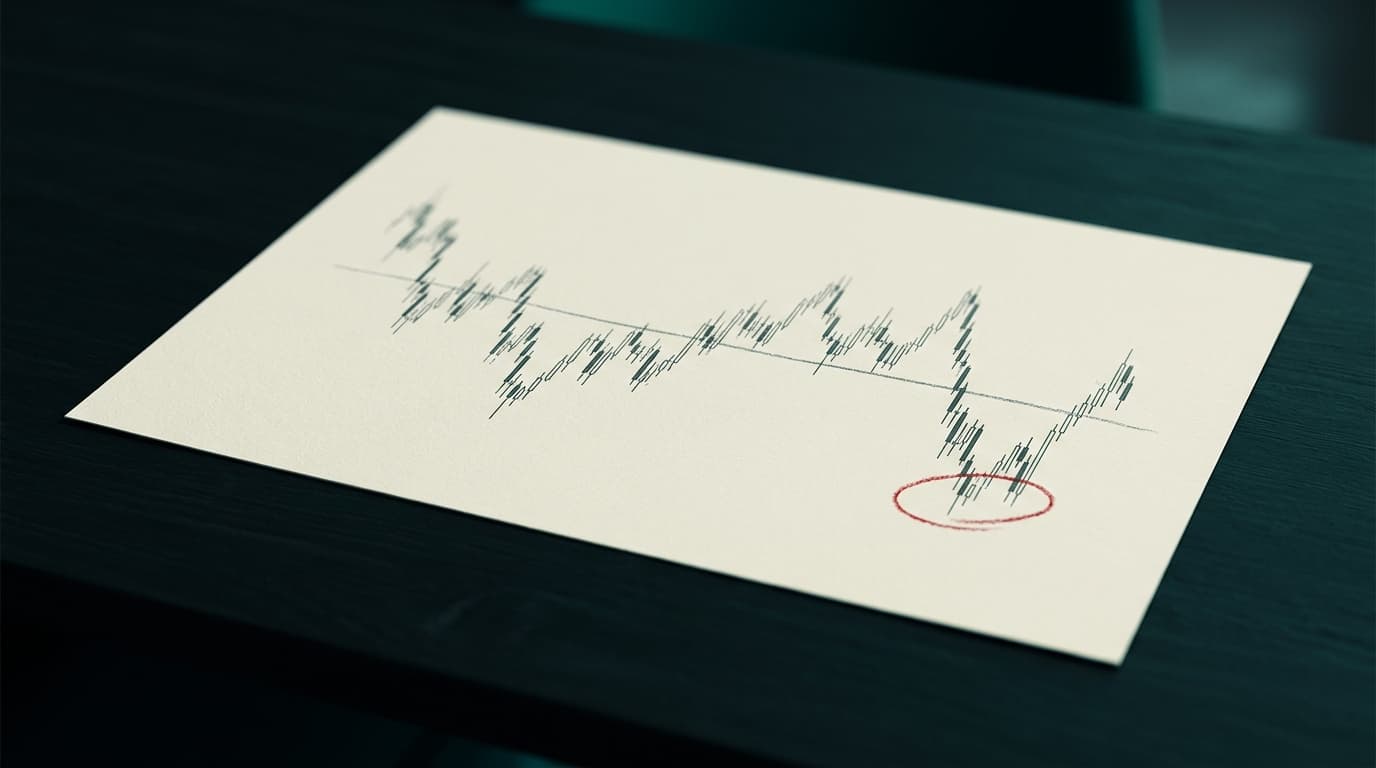
Every retail trader gets sold the same fantasy. A high-impact economic print is about to drop, the chat rooms are buzzing, the broker's spreads have widened pre-emptively, and a clean directional candle prints in the first ten seconds. The trader chases. Within forty minutes, price has retraced back through the entry, taken the stop, and continued in the original direction without them. They did not misread the print. They got fed the print's fingerprint, not the print's signal. The news fade is not a strategy retail can monetise; it is a structural feature of how institutional re-pricing works after headline prints, and the more useful angle is to learn to read the print's aftermath rather than chase its first candle.
This piece walks through the mechanics of how post-print price action actually forms, why the initial impulse is so often the worst entry of the day, and what an educational read of the news fade looks like inside the Tradoki curriculum. It is not a how-to-trade-the-news playbook. It is the thing we wish someone had walked us through before we tried.
What actually happens in the first ten seconds
The print drops. The market does three things almost simultaneously.
First, liquidity providers widen quotes. The bid-ask spread on EUR/USD at the moment of an NFP print can momentarily expand by an order of magnitude relative to the calm minute prior. That widened spread is the cost the dealer is charging for taking the other side of any unhedged order in a moment when fair value is genuinely uncertain.
Second, the initial directional move prices in the headline number. If the headline beat consensus, futures and spot lurch in the headline-favoured direction. This move is mechanical — algorithmic systems hard-coded to react to the headline value execute first, and they take the available liquidity at whatever price clears the spread.
Third, the market starts re-pricing the details. Headline prints are summaries. The detail components — wage growth versus unemployment in payrolls; core versus headline in CPI; dot-plot revisions versus the rate decision in central-bank meetings — frequently tell a different story from the headline. The institutional flow that reads the details is slower because the read is harder. It arrives in the next 5 to 30 minutes.
The retail trader sees the first move and reacts to it. They see a clean directional candle, click market-buy or market-sell, and get filled at a worse price than the candle they were looking at — because the spread was wider than the chart showed, because their broker added slippage, and because the price has already moved another tick by the time their order routes. By the time the institutional re-price arrives in the opposite direction, the retail trader is on the wrong side, oversized, and already in drawdown.
Why the headline is rarely the signal
The intuitive retail mistake is to treat the print as a single number. It is not. A high-impact print is a report, and the report has structure. Inside that structure are subcomponents that revise expectations of the next print, of the central-bank reaction function, and of forward growth.
Take a non-farm payrolls release. The headline jobs number is one line of a multi-page release. The unemployment rate is a separate calculation from a separate survey. The hourly earnings number tells the inflation desk what they need to know. The prior month's revision quietly rewrites last month's narrative. The participation rate adjusts the meaning of the headline upward or downward.
The market sees the headline first because the headline is what the algorithms are programmed to react to. The market re-prices the report once the institutional flow has parsed the rest. The first directional candle is the headline reaction. The retracement, the consolidation, and the directional resolution that come next are the report reaction.
Retail trades the first thing. Institutional trades the second.
The fade pattern, structurally
What we describe inside the desk as the "news fade pattern" is not a single chart shape. It is a class of post-print behaviours with a shared underlying mechanism: the initial impulse runs into countering flow, retraces partially or fully, and the eventual session-trend direction is decided by the reading of the report rather than the headline.
The class has three rough sub-shapes:
The full fade. The initial impulse retraces back through the pre-print level inside 30 to 60 minutes. Common when the headline is offset by a damaging detail (a strong jobs print with a weak earnings number, for instance, where the rates desk concludes the central bank's reaction function has not actually shifted).
The partial fade and continuation. The initial impulse retraces 30–60% of its move and then resumes in the original direction. Common when the headline and the details broadly agree, and the institutional flow simply joins after parsing.
The pivot. The initial impulse extends, then reverses past the pre-print level, and the new direction holds for the session. Common when the headline misled — the report reads in the opposite direction once parsed, and the slower flow drives a session-long re-pricing the wrong way for whoever chased the first candle.
These are descriptive, not predictive. The point is that the first candle does not tell you which sub-shape you are in. Determining that requires watching the next 15–60 minutes — a window during which retail platforms have already filled the trade.
Why retail platforms structurally disadvantage you on prints
Even if a retail trader identified the right direction in advance, the execution layer would erode most of the edge. We see this on every cohort that asks us about news trading.
Spread expansion is asymmetric to your fill. A widened spread costs you twice — once on entry and once on exit. The chart on your screen shows mid-price; the fill happens against the worst side.
Stop runs are denser around prints. Liquidity providers know exactly where retail stops cluster (just past the prior swing high or low) and have no reason not to step price through them in a moment when the order book is thin. The post-print stop run is a regular feature, not a conspiracy.
Quote streams freeze. During the first 1–3 seconds, many retail platforms either pause quote streaming or display stale prices. A trader who clicks during this window is operating blind on the actual market state.
Routing latency stacks up. A retail order routes through a broker, often through an internal matching layer, often with last-look hedging. Each layer adds tens of milliseconds. The institutional algos that drive the first move are running co-located against the venue.
The cumulative effect is that even a directionally correct print read, executed by a retail trader during the first impulse, regularly results in a losing trade. The cause is not analysis. It is plumbing.
The educational alternative: read the post-print
The question we get every month from cohorts is "if you do not trade the print, what do you do?" The answer is that the print is information, and information is most useful when it has resolved into a regime, not when it is exploding into one.
The post-print read we teach has three pieces:
1. Wait for the volatility envelope to compress. A practical heuristic is to wait for at least three consecutive lower-high or higher-low closes on the entry timeframe — usually 15 minutes — before considering any setup. This typically takes 45–90 minutes after a major print. By that point, the headline-versus-report read has resolved.
2. Re-derive the bias on the higher timeframe. A high-impact print can flip the daily bias. The right move is not to use yesterday's bias and force a setup; it is to apply the top-down framework again from the bias timeframe down. Often the bias is now transitional and the day is no longer tradable.
3. If a setup forms inside the new regime, size it smaller. Post-print volatility is structurally elevated for the rest of the session. The same per-trade risk in a more volatile regime translates to larger absolute drawdowns. Cut the size; widen the stop. Do not do the inverse.
This is undramatic on purpose. The dramatic version is the headline trade and a chat-room screenshot. The educational version is a half-page journal entry and a smaller position size on a setup that may or may not occur. Most days, it does not.
— The Tradoki desk noteThe first candle after the print is the headline's signature. The session that follows is the report's signature. Retail trades the first one and is generally on the wrong side of the second.
The instruments that fade most cleanly
In our internal tick captures, the cleanest fade behaviour after major prints sits on the most liquid forex majors and the front-month equity-index futures. EUR/USD, USD/JPY and GBP/USD around US-data prints, and ES, NQ and DAX futures around their domestic prints, show partial-retracement rates inside the first 30 minutes that are consistently above 50% in our sample.
Less liquid pairs and less liquid stock futures show the same qualitative behaviour but with messier execution and wider noise. Single-stock equities trading off macro prints tend to behave idiosyncratically; the macro print is mediated through correlation, sector flow, and individual company exposure, and the fade pattern is much less reliable.
Crypto majors do not fade prints in the same way. Crypto liquidity is structurally different — there is no overnight institutional desk parsing reports — and the post-print response often lacks the institutional re-pricing leg entirely. Treating a US CPI print as a fade signal on BTC or ETH has, in our records, been a worse trade than treating it as a fade on EUR/USD by a wide margin.
For deeper coverage of which assets to even consider for which strategies, see the asset selection framework.
What to put in the journal on print days
Every cohort, we ask traders to make print days a journaling exercise rather than a trading exercise for the first 30 sessions. The journal entry has four fields:
- The headline number, the consensus, and the prior.
- The first-candle direction and the depth of the initial impulse.
- The 30-minute and 90-minute outcomes (full fade, partial fade and continuation, or pivot).
- A one-paragraph read of why the report-versus-headline divergence drove that outcome.
After 30 sessions, the trader has a pattern recognition library that no chart-pattern tutorial can supply, because it is grounded in the relationship between the print's content and the price's response. That library is the prerequisite to ever attempting a discretionary print trade — and most of our cohorts conclude, after building it, that they would rather not.
The structured way to build the library is in the trading journal template. The deliberate-practice arc that includes news days as journaling sessions is in the ninety-day plan.
● FAQ
- What is the news fade?
- The pattern in which an initial post-print directional move retraces — partially or fully — within the first 30 to 90 minutes. It happens because the initial print prices in headline expectations, and the slower-moving institutional flow re-prices the underlying details over the next session.
- Why does retail get trapped on prints?
- Retail platforms widen spreads, slip stops, and freeze quote streams in the first seconds after a print. By the time a retail order fills, the price is already past the initial impulse — meaning the trader buys the high or sells the low of the move.
- Should you ever trade the headline?
- As a discretionary strategy, no — the slippage and execution risk on retail platforms is structurally adverse. The educational angle is to study the post-print sessions, where price action is interpretable and execution is normal.
- Which prints fade most reliably?
- In our records, single-headline prints — payrolls, CPI, central-bank rate decisions — fade more often than multi-component prints, because the initial reaction prices the headline and the detailed read takes longer to absorb.
- How do you size a post-print educational trade?
- Smaller than your normal sizing, with a stop wide enough to absorb post-event volatility. Many traders do the inverse and end up oversized on a wider-than-usual stop. We do not recommend live trading these prints.
Three more from the log.
Mean reversion on forex and indices: the 2026 edition
Mean reversion still works in 2026, but only inside narrow regimes. The framework we teach, and the failure modes we see retail traders repeat.
Oct 08, 2025 · 8 min
Prop Firm News Trading Rules Aren't All the Same
My Funded Futures runs a stopwatch, Apex bans the trade shape, Topstep restricts only CPI. Three funded-account rules, verified firm by firm.
Sep 02, 2026 · 7 min
ATR Stop-Loss Multipliers: The Number Nobody Explains
Everyone recycles '2x to 3x ATR' for stop losses. Here's where that number actually comes from, and why copying it is the wrong move.
Aug 29, 2026 · 6 min