
Mean reversion on forex and indices: the 2026 edition
Mean reversion still works in 2026, but only inside narrow regimes. The framework we teach, and the failure modes we see retail traders repeat.
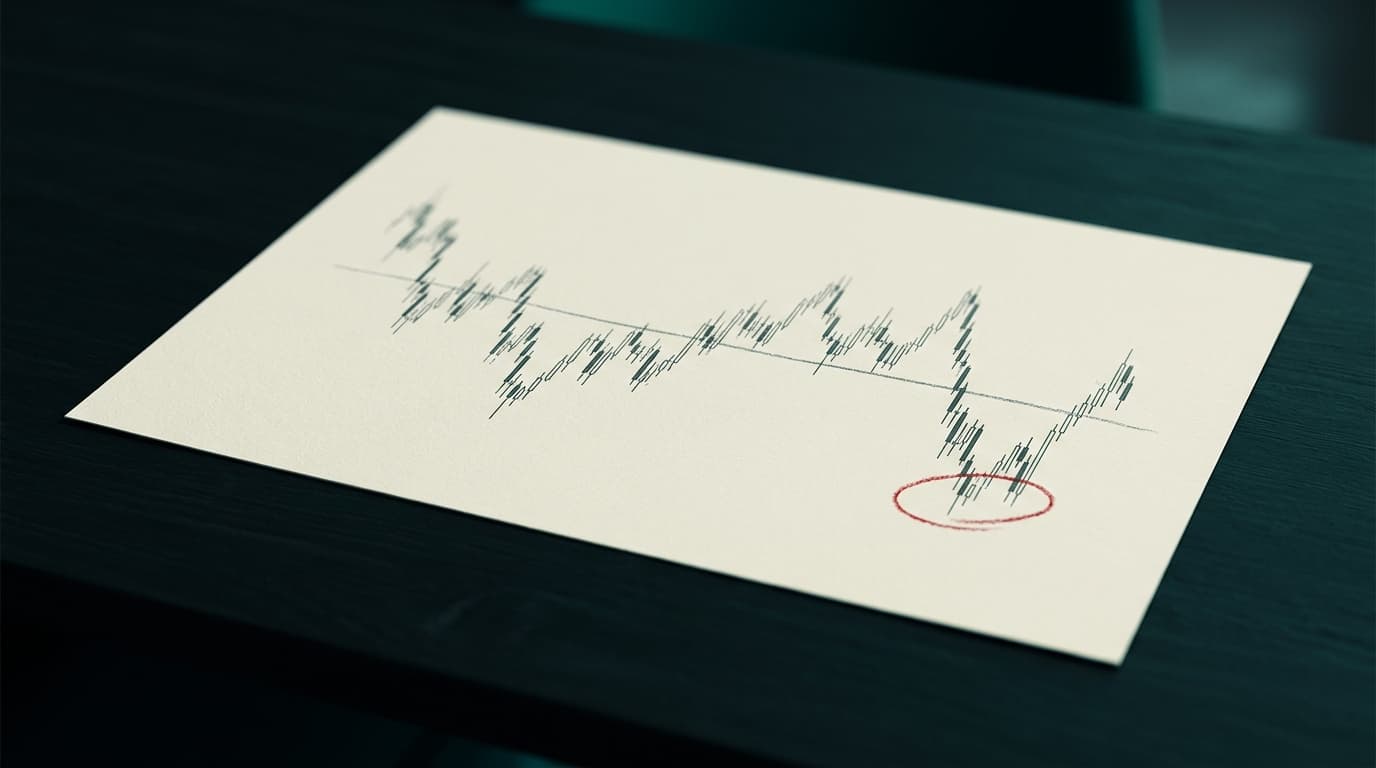
Every twelve months someone publishes the obituary for mean reversion, and every twelve months the desks that quietly run it keep showing up in next year's results. Both things have been true for thirty years. The version that worked five y
Every twelve months someone publishes the obituary for mean reversion, and every twelve months the desks that quietly run it keep showing up in next year's results. Both things have been true for thirty years. The version that worked five years ago is dead — spreads tightened, algorithmic liquidity changed who is fading whom, and the unfiltered RSI-and-Bollinger setups every retail course still sells stopped paying their way. Mean reversion still works in 2026 — but only inside narrow regimes, and the entire practical edge has moved off the entry signal and onto the regime filter that decides whether to take it.
What follows is the small, dull framework we teach inside the desk for deciding when a mean reversion strategy is the right lens, and the failure modes we have watched cohort after cohort repeat. It is not a system you can paste into a chart. It is the thinking that makes a trader stop blowing up the same way twice.
The regime is the strategy
The single biggest mistake we see is traders who pick a strategy first and look for markets second. Mean reversion is not a strategy in the sense of "a thing you do." It is a bet about the underlying behavior of the market you are looking at. If that bet is wrong — if the market is trending, breaking out, or compressing into a regime change — every entry signal you take inside it has negative expectancy, no matter how good the candle pattern looks.
So the first move is not "find the entry." It is "decide whether this market is even reverting."
We use four diagnostic questions:
- Is the volatility steady or expanding? Reversion lives inside steady or contracting volatility. ATR pushing into a fresh multi-month high is a tell that the regime is shifting.
- Are the higher-time-frame structures balanced or directional? A market making a clean sequence of higher highs and higher lows on the daily is not a reversion candidate, regardless of how stretched the 15-minute looks.
- Is liquidity normal? Holiday weeks, end-of-quarter rebalances and post-FOMC sessions have abnormal flow. Reversion logic that assumes "fade the extreme because liquidity providers will step in" requires those liquidity providers to actually be there.
- Is the news calendar empty? A high-impact print is a regime-change machine. The cleanest reversion windows are the boring ones.
Only when those four come back affirmatively do we even open the lower-time-frame chart to look for an entry. Most days, on most pairs, the answer is no — and the discipline is to not trade.
What the data has done to the old textbook setups
The textbook mean reversion indicators still get drawn in retail courses: RSI(2) on the close, Bollinger Bands fade at two standard deviations, mean-reversion to the 20-period moving average. They are not wrong as concepts. They are unselective, which is a different problem.
When we look back at the rolling out-of-sample performance of a naive RSI(2) fade on the EUR/USD 1-hour, the equity curve in the first half of the previous decade was clean and the equity curve in the last three years has been a slow grind sideways with episodic large drawdowns. The signal did not stop working. The unfiltered version of the signal stopped working, because the cost of being wrong on a regime-change day grew faster than the gain on the typical day.
The pattern repeats across every classic indicator-based reversion entry we have looked at: the gross signal still has skew, the unfiltered system has a Sharpe near zero. The edge moved into the filter.
What a regime filter actually looks like
A useful regime filter does not need to be elegant. It needs to answer one question reliably: "is this instrument currently inside a window where reversion has historically paid?"
Three filters that have held up in our internal walk-forwards:
1. Slope of the higher-time-frame moving average. A flat or slightly rising/falling 200-period SMA on the 4-hour chart is the simplest possible regime tag. When the slope is steep — past a small absolute threshold — the trend dominates and reversion entries die. The threshold is an instrument-by-instrument calibration; we do not publish the numbers because they drift, but the principle is portable.
2. ATR percentile rank. Take the 14-period ATR and rank it against the trailing 250 sessions. A reading above the 80th percentile usually marks a volatility expansion regime where mean reversion in volatile markets stops paying — the next print is more likely to extend than to revert. Skip those windows.
3. Range integrity. Mark the developing session range and require the entry to be inside it. The instant price closes meaningfully outside the prior balanced range, the regime tag flips and reversion logic is parked.
None of these are predictive in the magic-bullet sense. They are gating — they decide whether the entry signal is allowed to vote at all.
// Pseudocode for a daily regime gate, illustrative only.
const allowReversion = (bar: Bar, ctx: Context): boolean => {
  const slopeOK = Math.abs(slope(ctx.sma200_4h)) < ctx.slopeThreshold
  const volOK = percentileRank(ctx.atr14, ctx.atrSeries) <= 0.8
  const rangeOK = bar.close > ctx.rangeLow && bar.close < ctx.rangeHigh
  const newsOK = !ctx.highImpactWithin(60 /* minutes */)
  return slopeOK && volOK && rangeOK && newsOK
}
The gate is dumb on purpose. A complicated regime detector overfits the regime detector, which is the same disease one level up.
Entries are now small, sizing is now bigger
Once the regime gate is open, the entry is allowed to be unfashionably simple. We see no consistent advantage in the elaborate confluence stacks that retail courses keep selling. A two-standard-deviation extension (a z-score of roughly two on the standardised price) against a flat moving average inside a defined range — taken at the close of the bar that prints the extension, with a stop placed past the structural high or low that defines the range — is roughly as good as anything fancier we have tested.
What changes the equity curve is not a smarter entry. It is position sizing that respects the loss distribution of the strategy.
Mean reversion has a high win rate and a fat left tail. The trader who sizes it like a trend setup — risking 1% per trade because that is what they read in a book — will be fine for months and then meet a single regime-change loss that hands back six months of equity. The fix is mechanical: half the per-trade risk you would use on a directional setup, and a hard daily-loss kill switch. We cover the math in the risk of ruin pillar, which is mandatory reading before any reversion strategy goes live.
— The Tradoki desk noteA reversion trader who blows up did not pick the wrong entry. They sized the right entry as if it were a different kind of trade.
Forex versus indices: where the cleanest reversion lives
The two cleanest classes for mean reversion trading in 2026 remain the major forex pairs and the developed-market equity indices, for opposite reasons.
Forex majors revert because no single participant wants the price. The flow is dealer-led, two-sided, and globally distributed. EUR/USD, USD/JPY and GBP/USD inside their balanced ranges have historically been the textbook playground for fade strategies, because the price is constantly being pushed back to where the inventory is balanced. The risk is binary regime change — a central-bank pivot or a macro shock turns a textbook range into a textbook trend overnight. Treat the calendar like radar.
Equity indices revert because the volatility surface compresses them. Index futures sit on top of a derivatives ecosystem that systematically dampens overshoots — option dealers who short volatility on rallies and buy it on selloffs end up acting as a soft mean-reversion force. This is structural, not technical. It is also conditional on dealer positioning, which is why the cleanest index reversion windows tend to follow the monthly options expiry calendar more than they follow any indicator.
What does not work as well any more, in our records, is reversion on single stocks and on most crypto majors. Single stocks have idiosyncratic news flow that breaks ranges. Crypto has both directional regime persistence and structural illiquidity in the off-hours that produces wicks the textbook does not contemplate. We would not say never — the desk has run reversion trades on both — but the regime gate has to be tighter, and the position size smaller again.
For a deeper treatment of which markets to even consider, see the asset selection framework.
Failure modes we see in every cohort
Five repeat offenders, in roughly the order they bite:
-
Trading the entry without the regime gate. The most common, the most expensive. The entry signal is the same; the equity curve is night-and-day. Until the gate is mechanical, the strategy is not a strategy.
-
Adding to losers because "it has to revert." This is the trade that ends careers. The whole strategy depends on the regime not having flipped; adding more risk while the evidence accumulates that it has flipped is the opposite of the right action.
-
Using a moving stop on a reversion trade. Trailing stops are a directional tool. Reversion trades by construction expect chop; a moving stop will get clipped on noise on the way to the target.
-
Trading the same signal across uncorrelated regimes. A reversion setup that backtested cleanly on EUR/USD in 2017–2019 will not behave the same way on crypto majors in 2025. The signal does not transfer; the regime did not generalise.
-
Pretending the high-impact-news rule is optional. We have seen this in every cohort. The trader believes their setup is good enough to override the calendar. The calendar wins approximately 100% of the time over a long enough sample.
If the strategy were to be reduced to one piece of advice, it would be: put the gate before the gun.
A practical starting framework
For traders who want to actually do the work — and want to do it without immediately committing live capital — the framework we suggest inside the eight-week curriculum and in the ninety-day deliberate practice plan is roughly:
- Pick two instruments. Not ten. Two. One forex major, one index.
- Define your regime gate in writing. Specifically. Numerically.
- Define your entry trigger and your stop in writing. Specifically. Numerically.
- Paper-trade the strategy for at least 60 sessions, journaling every gate decision and every entry decision.
- Review the journal weekly. Look first at the gate calls — were the windows you traded actually inside-regime?
- Only after you can see the gate working should you consider sizing into live capital, and at a fraction of the risk you intend to eventually run.
It is unglamorous on purpose. The traders we see who survive are the ones who did the unglamorous version for long enough that the glamorous version became unnecessary.
● FAQ
- Does mean reversion still work in 2026?
- It works inside narrow regimes — range-bound majors, index volatility compressions, low-news windows. It fails the moment the regime changes, which is why regime detection matters more than the entry signal itself.
- What asset class is best for mean reversion?
- Forex majors and equity indices have historically offered the cleanest mean-reverting behavior, because both are dominated by liquidity providers who fade extremes. Single stocks and crypto trend more often than they revert.
- What is the simplest mean-reversion entry?
- A two-standard-deviation extension on a Bollinger band against a flat moving average, taken only inside a defined range. The simplicity is a feature — complex versions overfit and break first.
- How do you size a mean-reversion trade?
- Smaller than your trend trades. Reversion strategies have high win rates and large losers — the fixed-fractional rule that protects you is roughly half the per-trade risk you would use for a directional setup.
- What kills a mean-reversion strategy?
- A regime change — usually a central-bank pivot, a macro print, or a structural shift in volatility. Strategies that ignore regime and trade the same signal in every market eventually meet the trend that does not revert.
Three more from the log.

The news fade: when economic prints trap retail
Trading the initial spike on a high-impact economic print is one of the most reliable ways to lose money fast. Here is how the news-fade pattern actually forms and why retail keeps walking into it.
Dec 03, 2025 · 9 min
ATR Stop-Loss Multipliers: The Number Nobody Explains
Everyone recycles '2x to 3x ATR' for stop losses. Here's where that number actually comes from, and why copying it is the wrong move.
Aug 29, 2026 · 6 min
Anchored VWAP: where you anchor is the whole setup
Anchored VWAP has exactly one real input. Pick it after the move and you have built a hindsight machine. Here is how to pick it by rule instead.
Aug 17, 2026 · 8 min